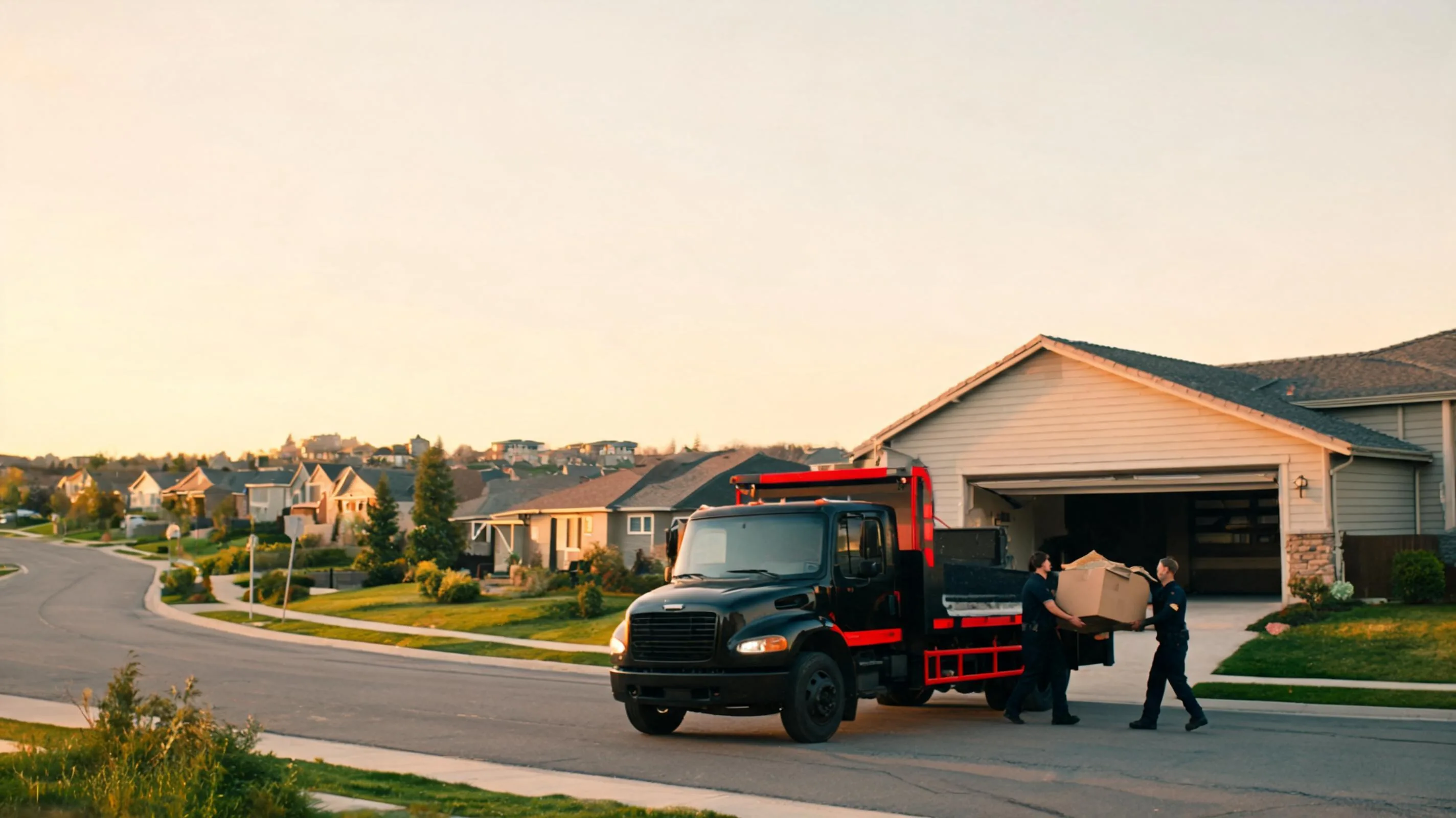
Calgary Junk Removal Door Hanger ROI: What 4,000 Doors Actually Earns
A walk-through of the unit economics behind a Calgary junk removal door-hanger campaign: cost per zone, expected calls, average ticket, and how to size the route for one truck day.
If you operate a Calgary junk-removal truck, you already know the demand signal does not start with a Google search. It starts when the homeowner walks past the garage, looks at the pile, and thinks I should really do something about that. The job is to be on the doorknob when that thought lands.
This post lays out the unit economics behind a single 4,000-door Calgary zone. The numbers come from AAR Junk Removal — a working StreetDrop client — plus published benchmarks for the trade.
What you spend, what you get
Here is the basic frame:
| Line item | Cost or value |
|---|---|
| 4,000-door StreetDrop zone, quarter page (design + print + delivery) | $400 |
| Inbound calls, first 14 days | 8–25 |
| Average ticket, Calgary garage cleanout | $300–$500 |
| Close rate on inbound (offer-dependent) | 35–55% |
At the conservative end (8 calls, 35% close, $300 ticket), that is 2.8 jobs and roughly $840 in revenue against $400 in marketing. At the high end (25 calls, 55% close, $500 ticket), it is closer to $6,800.
For comparison, Push Leads' 2025 benchmark puts paid-search CPL for junk removal at $35–$50 nationally. Calgary specifically runs higher because the auction is dense with cleanout franchises.
Why density matters more than reach for junk
A junk-removal truck day is a routing problem. One truck, two crew, eight stops, ideally on the same three blocks. A door-hanger zone is essentially a routing pre-condition — by saturating a contiguous block, you cluster the calls geographically before they happen.
When to drop in Calgary
The Calgary junk cycle has three peaks:
- April–June. Post-thaw garage cleanouts. The biggest single window of the year.
- July–August. Back-to-school moves, estate sales, downsizers preparing for fall.
- September–October. Pre-winter purges and basement cleanouts before snow loads the schedule with snow-removal work.
We typically recommend a base monthly drop with seasonal boosts in those three peaks. Commercial accounts — property managers, estate executors, real-estate prep — run steady year-round and respond well to a second hanger cadence on a 60-day cycle.
What you can prove to the operator afterward
Every StreetDrop campaign comes with the GPS trail. That matters in this trade for two reasons:
- You can show a referrer or franchisor exactly what was walked. Useful if you are part of a franchise system that wants distribution accountability.
- You can defend the spend internally. Owner-operators justify the $400 by overlaying the GPS map against the inbound call list — the streets walked correlate to the calls received.
Watch a sample drop
A sample drop on real Calgary streets, on the page our clients watch.
Sizing the first campaign
For a single Calgary truck, start with one zone. Pick a neighbourhood you already know — ideally one you can route in under an hour from your yard. Run it for a month, log every inbound call with the source question ("how did you hear about us?"), and review the GPS trail against the call log at day 30.
If the spread holds, expand to a second adjacent zone in month two. Most operators we work with are on two to three zones a month by quarter two, and the routing density across those zones becomes the moat.
What the wrong campaign looks like
To avoid survivorship bias: not every junk-removal drop wins. The campaigns that miss tend to share three traits:
- Generic offer. "Call us for junk removal" loses to "Same-day truckload — flat $299 garage cleanout, book by Saturday."
- No same-day promise. Junk is an impulse buy. If you cannot show up inside 48 hours, the door hanger gets recycled.
- Hanger design that buries the phone number. The phone number needs to be the largest element. We can fix that at design step but only if you tell us up front you want it tested.
If you want to talk through your offer before we print, the booking flow has a notes field on step three. Use it.