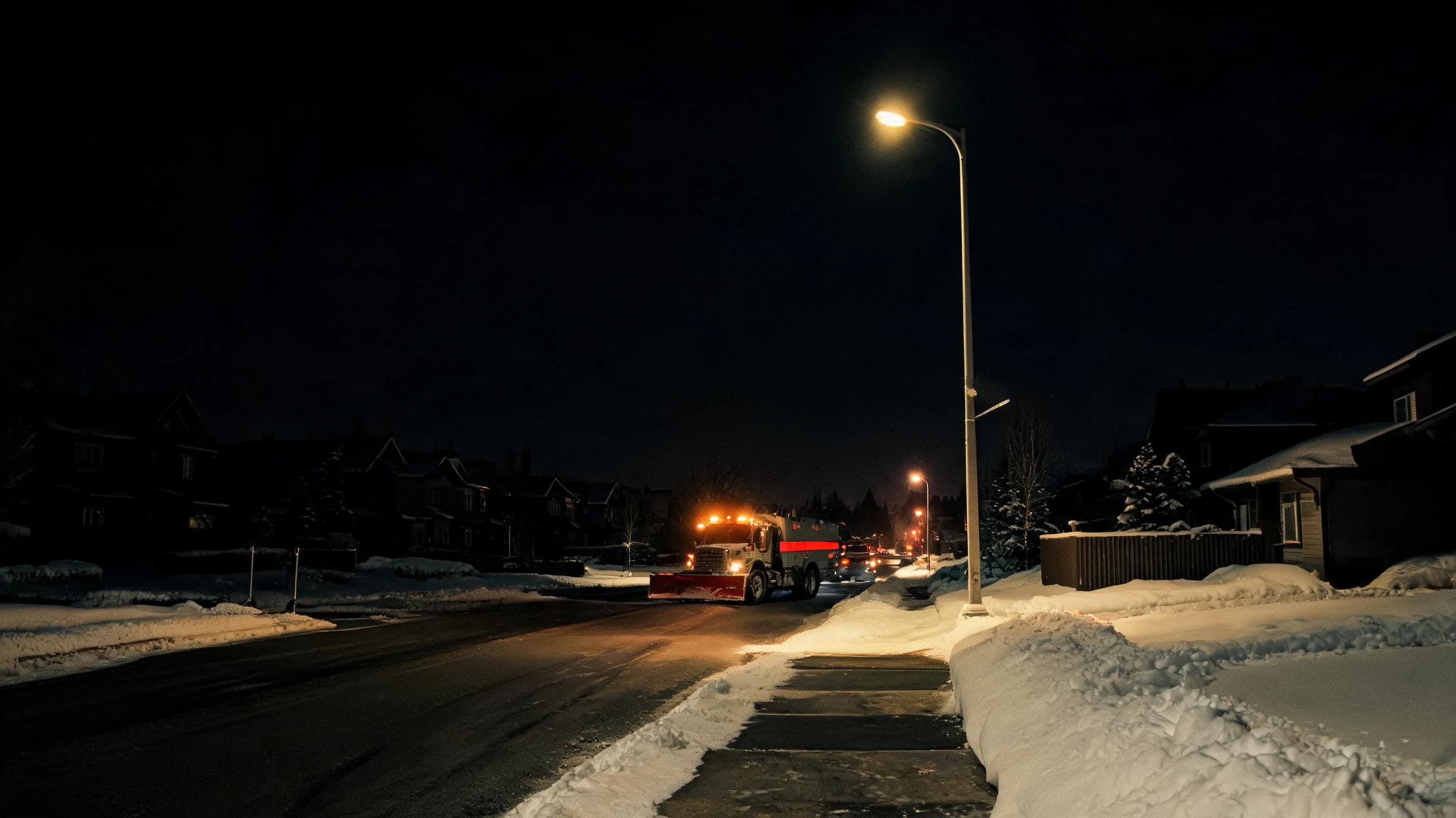
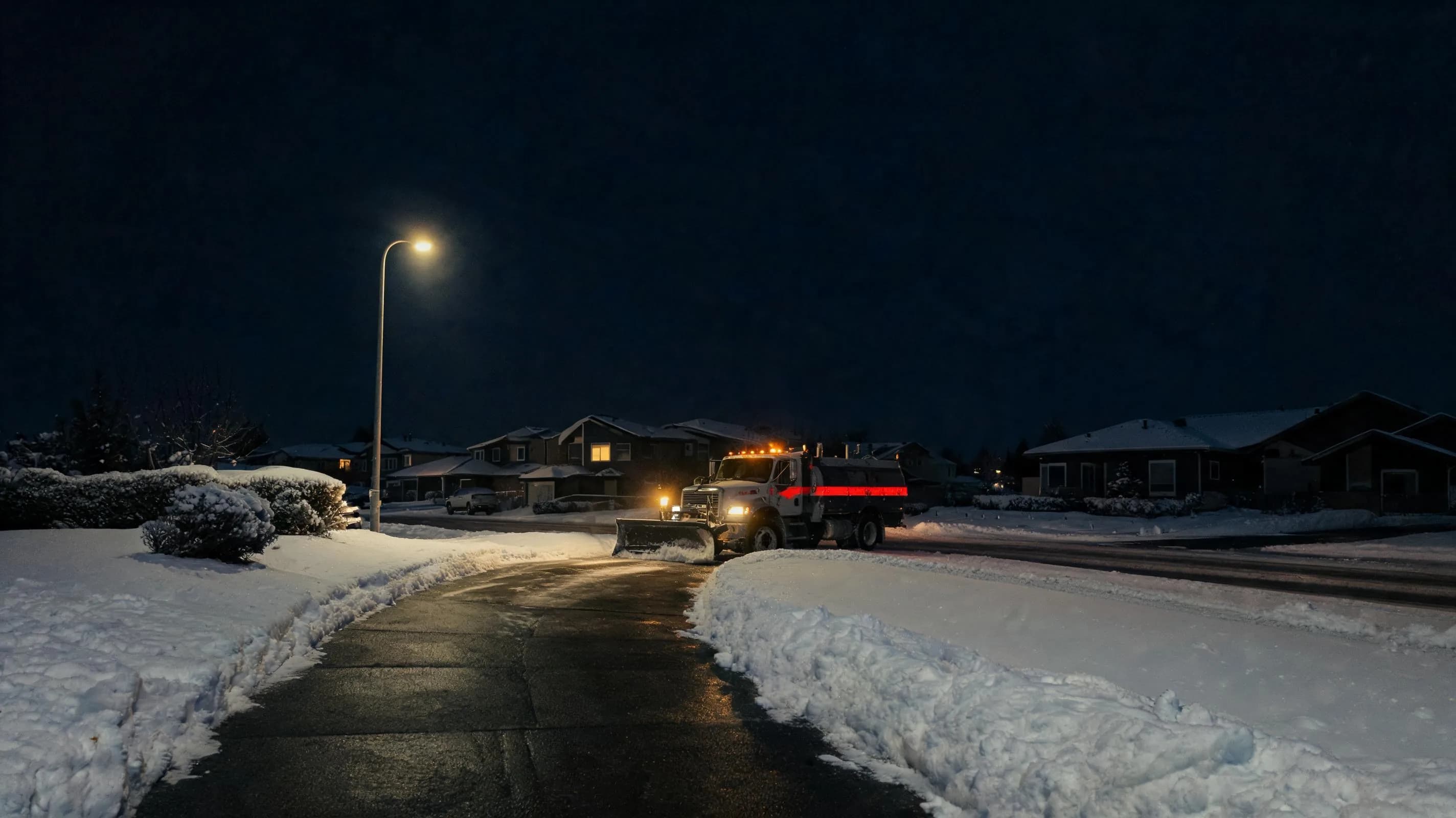
Locking in the Season: Selling Prepaid Snow Contracts at the Door
Per-push billing leaves money on the table and routes unpredictable. Here is the operator economics case for prepaid seasonal contracts — and the door-hanger copy framework that sells them in September and October.
Ask ten Calgary snow-removal operators how they price their work and eight of them will say some version of per-push. It feels fair: the homeowner pays for what they get, you charge for what you do. No awkward February conversation when it snows eighteen times in a month.
But per-push pricing has a problem that compounds every season: it makes your revenue completely unpredictable, your routes impossible to plan, and your cash flow dependent on the weather. The operators who scale past a handful of trucks are almost universally running a prepaid seasonal model — collected up front in October, routes locked before the first flake falls.
This post is about the economics on both sides of that transaction, and the hanger copy that makes a homeowner write you a cheque before they've seen a single snowstorm.
The operator case for prepaid seasonal contracts
The math on prepaid seasonal pricing is not subtle. A Calgary residential driveway push runs $35–$55 depending on size and access. In a moderate winter, a property might see 18–25 pushes. In a heavy one — 2020, 2022, both memorable — that number hits 32–38. In a light winter like 2018–19, some clients see 10–12.
At $45/push across 20 pushes, that homeowner represents $900 on paper. Prepaid seasonal contracts for comparable Calgary driveways run $550–$750 for the season, collected in October. On a light-snow year, you win. On a heavy one, the homeowner wins. Averaged across a typical fleet of 80 accounts, the math is close to neutral on gross revenue — but the structural advantages are not neutral at all.
Cash flow: You collect in October. Your equipment costs, insurance premiums, and crew wages run October through March. Prepaid funding means you enter the season financed. Per-push operators routinely carry 45–60 days of receivables through November and December, when the weather is worst and cash pressure is highest.
Route certainty: A prepaid account is a guaranteed stop. You build your route before the season, you staff to that route, you dispatch from a known plan. Per-push accounts call you on the morning of a storm when every other crew in the city is also dispatched, and you are making judgment calls about who gets prioritized at 5 AM.
Client retention: Prepaid clients who paid in October have mentally closed the file. They are not shopping around in January when a competitor drops a hanger in the middle of a cold snap. The psychological commitment of the upfront payment is, counterintuitively, one of the strongest retention mechanisms in the trade.
The homeowner case — and how to put it on your hanger
The homeowner who buys a prepaid seasonal contract is not buying price certainty. They are buying peace of mind — a fixed monthly reality where they never need to think about their driveway again from October to April.
The pitch, on a door hanger, should lead exactly there. Not the price. Not the features. The state of mind.
Here is a copy framework that works:
Headline: "Never think about your driveway again this winter."
This is a promise about cognitive relief, not service delivery. It resonates most strongly with the homeowners who value their time and mental bandwidth — the demographic who also has the disposable income for a prepaid commitment.
Sub-headline: "Lock in your seasonal rate now. Cleared before 7 AM every storm, all winter."
Two things happen in this line: (1) "lock in your seasonal rate" signals that prices go up if they wait, which is true — you fill routes and late callers get the remainder-of-season rate or a waitlist. (2) "before 7 AM" is the performance promise that matters most to families with kids in school and two-income households leaving for work.
Body (60–80 words): Name the neighbourhoods. Specificity builds trust on a door hanger the same way a local area code does on a phone number. "We are fully booked in Bridgeland and Ramsay — opening 12 spots in Albert Park and Forest Lawn this month" communicates scarcity and social proof simultaneously.
CTA: A QR code landing directly on a booking page, not a homepage. Every extra click between the hanger and the contract is a drop in your conversion rate.
Per-push vs prepaid: the comparison table operators should run
The following uses a moderate Calgary winter (22 push events) and a single residential driveway with a standard walk.
| Metric | Per-Push ($45/visit) | Prepaid Seasonal ($650) |
|---|---|---|
| Revenue (22 pushes) | $990 | $650 |
| Revenue (10 pushes, light year) | $450 | $650 |
| Revenue (35 pushes, heavy year) | $1,575 | $650 |
| Cash in hand October 1 | $0 | $650 |
| Route certainty | Low | High |
| Client retention rate (est.) | 55–65% | 78–88% |
| Dispatching complexity | High (reactive) | Low (planned) |
The per-push revenue ceiling in a heavy year looks attractive — until you account for the fact that a heavy year is also your most operationally stressed year. Equipment runs harder. Crews work longer. Service complaints increase. Per-push pricing charges more in exactly the months when your margin on each push is lowest.
Prepaid smooths all of that. The price the client paid in October is done. You enter a February blizzard with zero billing friction and 100% of your capacity focused on service.
The September–October hanger window
As covered in the snow-removal cluster at /blog/industry/snow-removal, the residential contract window in Calgary opens in late September and closes hard by the end of October. Prepaid selling has an even tighter window than per-push acquisition.
Per-push clients can be sold year-round — someone who misses the October window will call in November when the first storm hits. Prepaid clients need to commit before the season exists. They need to pay money for a service they have not yet received any value from. That psychological lift requires time and the right emotional context — which is early October, when the first cold snaps arrive and the memory of last February's driveway chaos is still accessible.
The most effective drop cadence for prepaid contract hangers:
September 20–28: Soft open. "Lock in your seasonal rate before October." This hits the proactive homeowner who books everything early. Expect lower volume, higher close rates.
October 1–10: Primary drop. The window is open. Lead with scarcity — "12 spots remaining in your area." This is where the majority of your prepaid contracts close.
October 15–25: Final push. "Storm season starts in days. Last chance for a seasonal rate — calls after October 31 are per-push only." This is the urgency close for procrastinators.
What to do with GPS delivery proof at contract time
One underused advantage of a GPS-tracked door-hanger campaign is the documentation it gives you for post-season client conversations. You know which streets received your hanger. You know which calls came from which zones. After one season, that overlay tells you where your prepaid renewals are concentrated and which adjacent streets are worth targeting the following September.
A snow-removal operator running 80 prepaid accounts in, say, Cranston and Auburn Bay can identify — from a single StreetDrop GPS trail — that Mahogany to the south has the same housing age and density, and is the logical next zone expansion. The hanger campaign and the route math reinforce each other.
Watch a live Calgary route
Live GPS proof — opens the StreetDrop portal demo.
This is also the data that justifies the second drop. If your October 1 zone in Evergreen generates 11 calls, the October 15 adjacent-zone drop in Signal Hill is not a guess — it is an informed extension of a confirmed signal.
The snow-removal operator playbook at /for/snow-removal covers zone selection and drop timing in full. The specific mechanics of building a prepaid route start there.
The one-sentence summary for your hanger
Everything above can be distilled to a single pitch your hanger has eight seconds to make: "Pay once in October, never worry about your driveway until April." That is the prepaid snow contract, described as a life improvement rather than a billing arrangement.
The operators who sell out their prepaid routes every September are not the ones with the lowest price. They are the ones who understood, early, that they were selling freedom from a recurring anxiety — not plowing visits.